Posted: November 1st, 2013 | Filed under: Fishy Apple, Fishy Corn, Fishy Soy, Fishy Sugar Beet, Fishy Tomato, Press Release | Tags: 24D, Adam Eidinger, Cesar Maxit, David Bronner, Dicamba, Dr. Bronner’s Magic Soaps, GMO, GMO Labeling, Rica Madrid, Tri-Coastal Tour, Yes on 522 |
|
FOR IMMEDIATE RELEASE
November 1, 2013
|
CONTACT: Adam Eidinger 202-744-2671
[email protected]
|
Fishy Food Cars Announce
6,000 Mile Tri-Coastal Tour
Journey from Seattle to New York for GMO Labeling Begins November 7
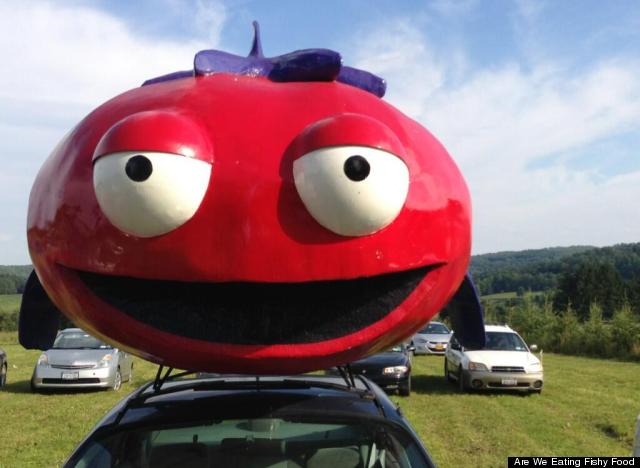
WASHINGTON, DC – On November 7, GMO labeling activists will set out on a cross-country 6,083-mile journey from Seattle to New York City for the “Are We Eating Fishy Food? Tri-Coastal Tour.” The tour features five mutant GMO art cars fitted with 300 pound roof-mounted sculptures that call attention to the need for labeling genetically engineered (GMO) food. The tour begins two days after the world learns if voters in Washington state approved I-522 requiring labels for food that has been genetically engineered.
The food democracy activists hope their second cross country tour will further activate Americans on the need for the Food and Drug Administration (FDA) to label GMO food as is done in 64 other countries. A video with highlights from the first cross-country tour can be found at www.AreWeEatingFishyFood.com along with background on each of the art cars.
“The Fishy Food art car fleet’s cross-country swim from Seattle to New York will get people talking about the importance of GMO labeling,” says David Bronner, President of Dr. Bronner’s Magic Soaps, whose company supported the creation of the art cars.
The first tour visited thirteen states and nine state capitals in August in a 3,300-mile journey from Washington, DC, home of the fishy food cars, to Seattle to support Yes on 522 campaign. The new Tri-Coastal Tour will follow a complete schedule and can be found at www.AreWeEatingFishyFood.com/tour/
“People want healthier food than what GMO food has to offer,” says Rica Madrid, coordinator of the Are We Eating Fishy Food? Tour. “You can measure the impact these educational vehicles have by the reaction and excitement they generate and the large number of shares we see in social media,” says Madrid.
Since 2011 citizen activism has pushed for information about what’s in our food. That year, the Right to Know March for GMO labeling walked 313 miles from Brooklyn, NY to the gates of the White House in Washington, DC to demand President Obama act on his promise to label GMO food.
Genetic Engineering means more herbicide. Chemical companies genetically engineer DNA from bacteria into food crops to either produce or tolerate the chemicals they sell. No long-term independent safety studies have been performed on adverse health effects of GMO eating GMOs. Overuse of pesticide creates resistant superweeds and superbugs, which leads to increased chemical application. Now chemical companies like Monsanto and Dow are engineering resistance in food crops to much more toxic weed killers like Dicamba and 2,4 D, the main ingredient in Agent Orange.
Currently 64 countries—EU nations, China, Russia, Japan, Brazil, and South Africa included—require labeling of GMOs; US consumers can currently only rely on voluntary labeling to determine whether food products have been altered through genetic engineering.
Origins of the FishyFood Cars
The first car in the Fishy Food fleet was “Poppy,” aka the Fishy Corn Car. Created in September 2011 by César Maxit and the DC51 Artist Collective, Fishy Corn accompanied the Right2Know March, as a support vehicle carrying leaflets, organic snacks and water as it raised awareness with marchers. Fishy Corn then went to Monsanto headquarters in Creve Coeur, Missouri for the 2012 annual shareholder meeting with activist Adam Eidinger. He parked the car on the agribusiness giant’s campus and debated Monsanto’s CEO Hugh Grant on GMO labeling during the meeting. A secret video of the encounter went viral online shortly afterwards.
In January 2013, Maxit began building four more mutant cars using extensive volunteer labor from the Washington, DC artist community. Since then, Fishy Sugar Beet aka “Rooty,” Fishy Apple aka “Goldie,” Fishy Soybean aka “Soja Girl,” and, most recently, Fishy Tomato aka “K-Sup” have driven across America. Collectively, the cars have been driven over 120,000 miles.
Members of the media are encouraged to embed with the Are We Eating Fishy Food? fleet for some or all of the tour. Contact Adam Eidinger at 202-744-2671 or [email protected] to make arrangements.
More information at www.AreWeEatingFishyFood.com
###
Posted: August 23rd, 2013 | Filed under: Fishy Tomato, Press | Tags: Adam Eidinger, Consumers, Creve Coeur, Daisy Alioto, DC, FDA, Fishy Fleet, Food Labeling, Genetic Engineering, GMO, GMO Labeling, Missouri, Monsanto, Occupy Monsanto, Ohio, Perry County, Protojournalist, Shareholder Resolution |
News Letter: Swimming With ‘The Fishy Fleet’
by DAISY ALIOTO, August 23, 201311:11 AM
Dear Protojournalist,
Traveled from DC to Missouri in mid-August with “The Fishy Fleet” (an offshoot of anti-GMO protest group Occupy Monsanto). It was a convoy of 17 activists piled into a 1960s-era RV and 5 “fishy” cars with friendly looking frankenfood sculptures on top…
Near Pittsburgh the fleet held up traffic when a toll booth attendant took a pix with her iPhone. One Ohio woman, who followed “Fishy Sugarbeet” into a gas station, proclaimed: “That’s the freakiest thing I’ve seen in Perry County — lately!”…
Outside Monsanto Corporation’s global headquarters in Creve Coeur, Mo., company stock holder and convoy organizer Adam Eidinger read aloud from his shareholder resolution asking Monsanto to “work with the FDA to develop food labeling guidelines for American consumers that discloses whether genetic engineering was used to produce the food”…
When asked for a statement, Monsanto says it supports voluntary labeling, but that mandatory labeling in the “absence of any demonstrated risks…could imply that food products containing these ingredients are somehow inferior to their conventional or organic counterparts.”
That’s all for now…
-Daisy
Source:
NPR
Posted: August 14th, 2013 | Filed under: Fishy Apple, Fishy Corn, Fishy Soy, Fishy Sugar Beet, Fishy Tomato, Press | Tags: Adam Eidinger, Arctic Apple, Biotechnology, GMO, GMO Labeling, Jazmin Rumbaut, Library Square, March Against Monsanto, Monsanto, Nikolas Schiller, Securities and Exchange Commission, St. Louis, Tami Canal |
(Matthew Piper | The Salt Lake Tribune) On Tuesday in Library Square, Nikolas Schiller sits besides Goldie the apple, which he is driving 3,300 miles across the country to raise awareness of GMO foods.
Cross-country drive aims to show there’s something ‘fishy’ about GMOs
By Matthew Piper, The Salt Lake Tribune
First Published Aug 13 2013 04:18 pm • Last Updated Aug 14 2013 09:50 am
Apparently, there’s no real trick to driving with a 4-foot-tall apple-fish on your roof. Just be wary of drive-by photographers.
Activist Nikolas Schiller drives Goldie, a Ford coupe that carries piggyback a cartoon sculpture made from welded steel, chicken wire, paper, fiberglass and glaze. The extra weight restricts gas mileage, but Schiller says Goldie’s got a bigger problem than her road readiness. Goldie is “fishy,” like the genetically manipulated “Arctic Apple” that never browns and is currently awaiting USDA approval.
Nineteen activists who oppose genetically engineered (GMO) foods brought their Fishy Food fleet to Library Square on Tuesday morning, drawing a handful of local activists and curious looks from passersby. The group, formerly known as Occupy Monsanto, is on a 3,300-mile cross-country tour from Washington, D.C., to Seattle to deliver the cars at Seattle Hempfest and support Washington state’s Initiative 522 to mandate labeling of GMOs.
GMOs have become an increasingly hot-button issue, even though the federal government and many scientists have found no evidence that the technology is unsafe.
Occupy’s previous demonstrations against Monsanto include a 2011 march from New York to Washington and civil disobedience. Fishy Food is an attempt to cultivate a more likable popular image. The five cars feature child-friendly structures designed by former architect Cesar Maxit and a variety of grass-roots volunteers — besides Goldie, there is Poppy, the corn; Rooty, the sugar beet; Soja Girl, the soy bean; and K-Sup, the tomato. DaVeat, a genetically modified bagel-fish (in “poop brown and fuchsia”) is in production.
“People are already on our side, we just need more people to know that they’re on our side,” says D.C. native Jazmin Rumbaut, who takes turns at the wheel of the sugar beet. “It’s actually kind of funny that we have to do something so goofy to bring attention to something that is so reasonable.”
Many in the group were anxious to meet Farmington resident Tami Canal, 31, who organized the international March Against Monsanto in May. Canal credits her daughters Jenna, 7, and Charlotte, 20, for inspiring her to take a stand against GMOs, and said she’d join Occupy Monsanto on the cross-country tour if she didn’t have to take care of her kids.
“I think these people are warriors,” Canal says. “I think it’s incredible what they’re doing. They’re sacrificing comfort and being away from their own families to spread this awareness.”
Opposition to GMOs is based on what activists say is a lack of research and awareness of genetic engineering, which is largely done to make crops more resistant to pesticides. In the case of the Arctic Apple, engineering would keep apples on store shelves much longer and reduce waste.
One of the activists, Adam Eidinger, is a Monsanto shareholder who has presented a measure to conduct an organic liability study at previous shareholder meetings. Eidinger announced last week in St. Louis at Monsanto’s company headquarters (the only place the Fishy Food fleet got a “thumbs down,” Eidinger says) that he has introduced a new shareholder proposal to label GMOs. He expects it to fail, but says Securities and Exchange Commission regulations dictate that shareholders will have to provide, in writing, a reason for rejecting the proposal.
Source:
Salt Lake City Tribune
Posted: August 5th, 2013 | Filed under: Fishy Corn, Press | Tags: Adam Eidinger, Andrea Roane, Capitol, Cars, GMO, GMO Labeling, WUSA9 |
WASHINGTON (WUSA9) — Monday evening you may see some funny looking cars on the road near the Capitol. They’re called “Fishy Food Cars” and they’re part of the “Are We Eating Fishy Food Campaign.” It’s a movement to get genetically modified food labeled.
One of the organizers, Adam Eidinger, joined us on Monday morning.
Source:
WUSA9
Posted: August 1st, 2013 | Filed under: Fishy Apple, Press | Tags: Adam Eidinger, Apple, BASF, Bayer CropScience, Car, Cesar Maxit, Dow AgroSciences, Dr. Bronner’s Magic Soaps, DuPont, FDA, GMO, GMO Labeling, I-522, Mark Lynas, Monsanto, Nikolas Schiller, Proposition 37, Syngenta |
By Amanda Peterka, E&E reporter
Published: Thursday, August 1, 2013
Copyright 2013, Environment and Energy Publishing LLC.
Reprinted with permission.
Nikolas Schiller is used to receiving odd looks as he drives through the streets of Washington, D.C.
In fact, he can’t commute to and from work without pedestrians whipping out their smartphones to take pictures, drivers leaning out of their windows at traffic lights to ogle and children’s eyes opening wide.
That’s because a huge, brightly colored sculpture fusing a golden delicious apple and a goldfish with eyes is bolted to the top of his used black Ford Escort — which itself has bright pink stripes down its side.
“It’s been an interesting experience,” said Schiller, a 32-year-old St. Louis native sporting a ponytail, T-shirt and cutoff jeans. “I have a lot of fun driving it around. It brings a lot of joy. I see people’s faces smile, light up, point, kids laugh, giggle, people take photos — it’s not like a normal car.”
Goldie the car
Nicknamed “Goldie,” it is one of five “fishy food” cars driving around Washington in recent weeks to promote the labeling of genetically modified food. Others carry sculptures of a corn cob, soybean, sugar beet and tomato.
They are the brainchild of the Mintwood Media Collective, a small public relations firm in D.C. that also is active in hemp issues, and local artist César Maxit. Funding was donated by Dr. Bronner’s Magic Soaps, an organic and fair-trade soap company.
Next week, the cars will depart on a 3,000-mile journey across the country ending in the state of Washington, where a fierce battle is being waged between food companies and anti-GMO activists over a November ballot measure to require the labeling of all foods containing genetically engineered ingredients.
The cars will pass through Pittsburgh; Columbus, Ohio; Indianapolis; Chicago; Denver; and Salt Lake City before reaching their final stop in Seattle. They’ll join in protests and press conferences and stop at Monsanto Co.’s global headquarters in Missouri along the way.
For the past several weeks, though, they’ve been circling D.C. in a bid to raise awareness of the nationwide campaign to label GMOs.
As Schiller passed through the heart of downtown on a recent rush-hour commute home, several people stopped to gawk in the middle of intersections. A young girl with auburn hair pulled her father’s arm excitedly, grinning ear to ear.
“It’s about making sure that customers and consumers in America are informed about their food purchases,” Schiller said as his car passed K Street lobbyists and tourists alike.
The current push to label genetically modified food began about two years ago with a march from Brooklyn, N.Y., to the White House. Supporters argue that genetically engineered foods have not been proved safe for human consumption and that Americans should have the right to choose whether to purchase foods with ingredients that have been genetically modified.
The first of the cars — Fishy Corn — made its debut at the 2011 march, driving the entire route. At that time, its sculpture was built of a steel frame wrapped in chicken wire and covered in spray-painted packing tape.
The designs have been updated since then. Their bones still consist of a steel frame wrapped in chicken wire, but they now have a hard fiberglass shell. Goldie was designed in January of this year, with a Ford Escort purchased for the purpose. The sculpture is bolted down through the roof and can be removed if necessary, but it takes about six people to hoist it off the car.
“We use the fishy food as a metaphor. Not all these products have fish genes in them. We use it as a metaphor that there’s something fishy about it,” said Adam Eidinger, an activist shareholder with Monsanto who drove the Fishy Corn car from New York to D.C. in 2011. “If you don’t know what it is, it’s something fishy. That’s why we’re winning — that’s common sense.”
The battle over labeling hit new heights last year in the months leading up to the November elections in California, where a ballot measure would have required food companies to label all foods that contain genetically engineered ingredients. Food companies and trade organizations poured more than $40 million into a campaign to oppose the measure, and it was defeated 53 percent to 47 percent.
“Unfortunately, Prop 37 didn’t pass but in its failure was quite a large win for awareness building,” said Schiller, who first became involved in the campaign at the 2011 march, when he drove a 14-foot box truck that carried supplies for the walkers along the 313-mile route. “All of a sudden Americans were actually talking about that when there hadn’t been much talk about it for the last decade.”
This year, legislators in more than 20 states introduced measures to require the labeling of GMOs. Connecticut recently became the first state to enact a law requiring food companies to label products with genetically engineered ingredients, though the law is contingent on other nearby states putting in place similar measures.
Supporters see Washington state as the main battleground and are hoping that successful passage of ballot initiative I-522 there will spur action on a national level, either in the form of a national law or Food and Drug Administration action to require labels.
Public polling has shown that American consumers overwhelmingly support the labeling of genetically engineered food. More than 60 countries also carry labeling requirements.
But food manufacturers and biotechnology companies that oppose labeling cite costs and say that such labels would be misleading because the majority of science on genetically modified food has shown them safe for human consumption.
In the wake of the heightened debate over genetically modified organisms and the recent discovery of unapproved genetically engineered wheat in a farm field in Oregon, Monsanto, BASF Corp., Bayer CropScience, Dow AgroSciences, DuPont Co. and Syngenta AG this week have banded together to launch a website, GMOanswers.com, to address health concerns with the foods.
“We oppose current initiatives to mandate labeling of ingredients developed from GM seeds in the absence of any demonstrated risks,” Monsanto says. “Such mandatory labeling could imply that food products containing these ingredients are somehow inferior to their conventional or organic counterparts.”
‘What’s this part of?’
In D.C., the “fishy” cars have attracted wide attention on the street and in social media. After circling the city, Schiller will log on to Twitter to see who has posted photos of Goldie — usually there are several people — and will respond in the voice of the vehicle.
Although the car is registered in his name — and is Schiller’s first vehicle as an adult — it will soon be handed over to activists in Washington state until at least after the November elections. He has been making the most of it before that happens and taking long, roundabout routes to and from his office in Adams Morgan, a hip neighborhood in the nation’s capital.
During rush hour earlier this week, as Schiller stopped Goldie at a light in downtown D.C., a bicyclist rode up in the bike lane next to the passenger side of the car. He tapped on the window.
“I saw these all over. … What’s this part of?” the man asked.
Schiller handed the cyclist a palm-sized bright-blue pamphlet fresh off the presses that relays the group’s main talking points. The pamphlet was designed by Maxit, the same artist who designed the structures for the tops of the cars.
“Oh, you guys are doing GMO stuff,” the cyclist responded. “Very great. I’ll pass it on. Thank you.”
Encounters like that are not uncommon. Schiller said he normally explains that the car’s name is Goldie and she’s half goldfish, half golden delicious. While there isn’t a genetically engineered apple on the market, the Agriculture Department is currently reviewing an application for one that doesn’t turn brown when stored.
Schiller will take the car in for detailing before next week’s cross-country drive. The car will be painted with messaging describing its missions. Up through this week, though, it’s been unlabeled — like GMOs, Schiller quipped.
Inquisitive pedestrians are usually receptive to the car’s message, he said.
“They give the thumbs up and go like ‘I want food labeled’ or ‘I don’t want to eat that stuff,'” he said. “Most people don’t realize that they’re eating it so there’s this disconnect between the knowledge of the food that they’re actually eating and the knowledge of the food that they don’t want to be eating. Generally, if you’re eating a processed food that came out of a box at the supermarket, it likely has a genetically engineered ingredient. But since it doesn’t say ‘genetically engineered ingredient,’ they’re not going to know that that’s what it is.”
Since the 1990s, the Food and Drug Administration has officially held the position that genetically engineered foods do not require special labeling. There are eight genetically modified crops currently available in the United States: corn, soybeans, cotton, canola, alfalfa, sugar beets, papaya and squash.
“The policy states that FDA has no basis for concluding that bioengineered foods differ from other foods in any meaningful or uniform way,” FDA says, “or that, as a class, foods developed by the new techniques present any different or greater safety concern than foods developed by traditional plant breeding.”
The effects of mandatory labeling would be “positively damaging to public understanding of science,” Mark Lynas, an environmentalist who recently shocked the anti-GMO world by reversing his position to one in favor of genetically modified food, said at an event this month in D.C.
Industry, he said, would be better served by a widespread voluntary labeling system for non-GMO products that allows consumers to choose what types of food they wish to buy, he said.
“I think what’s a real problem is to have mandatory labeling, which will then totally restructure the whole supply chain, and we’ll have knock-on effects, which actually do affect food security in other parts of the world,” Lynas said.
In the absence of labeling, Schiller has been growing his own vegetable garden at his house in D.C. for several years and purchasing his groceries from Whole Foods, which announced earlier this year that it would require labels on all GMO products.
He’s expecting varied levels of turnout and plenty of stares at the stops along the route to Washington state next week. But he’s gotten used to the attention.
“It’s one of those things that becomes so normal that you don’t realize it’s there,” Schiller said. “The only thing that kind of reminds you is the fact that you’ve got people pointing and staring and taking photographs.”
SOURCE: Amanda Peterka, Greenwire, Environment and Energy Publishing
Posted: July 31st, 2013 | Filed under: Fishy Corn, Fishy Sugar Beet, Fishy Tomato, Press | Tags: Adam Eidinger, Arin Greenwood, David Bronner, DC, DNA, Dr. Bronner’s Magic Soaps, GMO, GMO Labeling, Hempfest, Huffington Post, HuffPost Green, Washington |
On August fish — sorry, make that August 5th — anti-GMO activists will be launching a nationwide demonstration with a visual punch.
Part of that punch is a car topped by a fish tomato sculpture, nicknamed Fishy Tomato, a reference to the much-vilified DNA Plant Technology hybrid that mixed a tomato with genetic material from the Arctic flounder. (The hope was that this twist would help the tomatoes be more durable, to stay mush-free longer. What they became is iconic to activists who favor restrictions on the production and sale of genetically modified food.)
Eighteen activists in six art cars, including Fishy Tomato (above), each affixed with a fish-mix sculpture — fish apple, fish soy, fish wheat, and so on — will travel from D.C. to Seattle’s Hempfest, with many stops in between, including one at the Missouri headquarters of Monsanto, a biotech company, for an overnight camping protest.
Organizer Adam Eidinger told The Huffington Post that the purpose of the demonstration is to show support for an upcoming Washington state referendum on GMO labeling and to have “at least a million” people see the cars.
“People who will get more interested in GMO issues,” said Eidinger.
“The Fishy Food art car fleet’s cross-country swim from Washington, D.C. to Washington state will get people talking about the importance of GMO labeling,” David Bronner, president of Dr. Bronner’s Magic Soaps — which helped pay for the cars — said in a media release.
It’s still not clear what the results will be — as much as some support regulation of tomatoes mixed with Arctic flounder genes, there are those who say such activists are anti-science fearmongers.
Either way, it’s bound to be a colorful journey — and one with a lot of pit stops. Eidinger said that the art cars, while making a strong message, only get about 11 miles to the gallon.
SOURCE:
Arin Greenwood, The Huffington Post
Posted: July 25th, 2013 | Filed under: Fishy Apple, Fishy Corn, Fishy Soy, Fishy Sugar Beet, Fishy Tomato, Press, Video | Tags: Adam Eidinger, Adams Morgan, Beth Parker, Cesar Maxit, DC, Fox, Fox 5, Grocery Manufacturers Association, Louis Finkel, MyFoxDC, Robin Bell, Seattle, TV |
WASHINGTON - Do you always know what you are eating? Consumers may not realize that some of the fruits and vegetables they eat are genetically modified.
Critics say these foods need to be labeled and some are taking that message to the street of D.C.
Cesar Maxit is an artist. On Thursday, his canvas is a Ford Escort. He is working on what is called the Fishy Fleet.
“The first look people have is a little bit of shock and astonishment, said Adam Eidinger.
People shocked to see the fleet on the streets of Washington, such as Fishy Corn and Fishy Tomato. They are trying to send a message with these vehicles.
“The way to do that we thought was to have these smiling protagonists — these smiling fishy characters, so we have the tomato and the apple and the corn,” Maxit said.
Their website is areweeatingfishyfoods.com. The fruits and vegetables that look like fish are supposed to represent genetically modified organisms (food) or GMOs.
Biotech companies are altering the genetic code of certain seeds. These activists say those foods should be labeled.
For the next week and a half or so,these cars will be tooling around D.C. After that, they will embark on a cross country trip.
“Basically our group is driving cross country to Seattle, Washington to deposit these fishy food cars with activists there who are going to campaign to label genetically engineered food,” said Edinger.
The labeling issue is on the ballot in Washington state this November. There is also a fight at the federal level.
Louis Finkel represents the Grocery Manufacturers Association. He says there is no danger.
“500 peer-reviewed research studies on a global basis have all concluded unequivocally there’s no material difference and no health risk associated with the technology,” he said.
The people at Fishy Food say consumers need more information.
“You drive down the road and someone will sit there with their mouth open and they don’t believe what they’re seeing,” said Robin Bell.
They say it is time to believe what you are seeing and know what you are eating.
Source: MyFoxDC