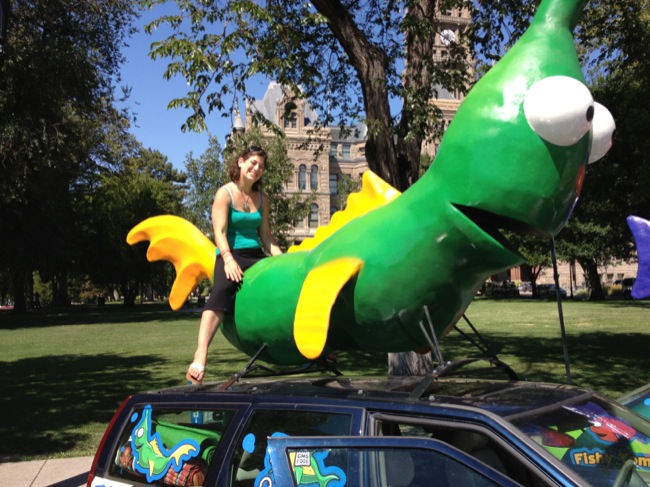
On August 5, 2013 a group of food labeling activists set out on a cross-country road trip from Washington, DC to deliver the fishiest cars in America to GMO labeling activists in Seattle, Washington. This video documents their epic 9 day, 3,000 mile journey across America.
Please help support GMO labeling in America by donating to the Yes on 522 Campaign.
Moms across America deserve to know what they are feeding their families. This mother spotted the Fishy Fleet while driving with her daughter last month. A big thanks goes out to mothers like her who have helped put Initiative 522 on the ballot in Washington state.
At the Seattle Justice Begins with Seeds Conference, Florence Vincent talks about the Yes On 522 campaign, shows a box of Kellogg’s cereal she purchased in the UK and driving grandmother, Label GMOs Initial Instigator and Chief Robble Rouser Pamm Larry around the state on her September Grassroots Speaking Tour.
Fishy Fleet tour driver Kate Bell, attorney, talks about the highlights of the coast to coast Fishy tour that got her to Seattle, GMOs and where she is going next on her world wide backpacking tour.
Riding around in a car topped with a giant half-vegetable, half-fish is bound to attract attention.
As Nikolas Schiller drives past the National Zoo in Washington, D.C., pedestrians gawk, kids point, and tourists snap pictures.
An oncoming driver pulls up in a stretch of slow traffic and asks, “What is it?”
Schiller explains it’s a Fishy Food Car and hands the man a card bearing a cartoon that asks, “Are we eating fishy food?”
It’s a visual pun. For opponents of genetically modified organisms (GMOs), there’s something fishy - suspicious - about putting genes from other species into food crops, and they want foods containing GMO ingredients to say so on the label.
Labeling laws
There are no fish genes in the GMOs on the market today, but nearly all of the corn, soybeans, cotton and sugar beets growing in the U.S. contain bacterial genes that help farmers control weeds and insects.
Schiller’s day job is with a D.C.-based public relations firm. But this summer his fishy apple car will join the fishy corn, soybean, sugar beet and tomato cars driving cross-country to Washington State, where a GMO labeling law is on the ballot this fall.
Momentum is behind them. Labeling laws were approved in Connecticut and Maine earlier this year.
Labeling everything containing a GMO ingredient would take a lot of ink. They’re in 80 percent of the foods on supermarket shelves, according to the Grocery Manufacturers Association, especially anything processed, in a bottle, box or bag.
Novel food
But are they bad for you? Schiller acknowledges that the only evidence of harm from GMOs is anecdotal, but he’s suspicious.
“This is a novel food. Our grandparents and previous generations didn’t eat this,” he said. “And now all of a sudden we’re seeing higher incidences of food and health issues. And so if [GMO makers] are saying, ‘Oh, everything’s safe,’ but nothing’s labeled, we really can’t trace the safety.”
Health authorities from the U.S. Institute of Medicine to the World Health Organization have said there’s nothing to fear from GMOs.
And the U.S. Food and Drug Administration says there is no substantive difference between GMO and conventional ingredients, so it can’t require labels.
On the other hand, products without GMOs may say so on the label, and these are now some of the hottest items in the supermarket. Last year, sales of certified-organic products grew 7.4 percent, twice the rate of the food sector as a whole. And foods with the “Non-GMO Verified” seal passed $1 billion in sales in 2011.
‘We should’ve been talking about this’
This has not gone unnoticed by the biotech industry.
This summer, the industry-sponsored Council for Biotechnology Information made an unusual, if understated, admission.
“We recognize we haven’t done the best job communicating about GMOs,” Executive Director Cathy Enright said in a press release.
She was more frank in person.
“We should’ve been talking about this for two decades,” she said, adding that in the last few years in particular, social media have taken opposition to GMOs to a new level. “We haven’t even been near social media.”
Transparency
But for opponents like Schiller, it’s not about a failure to communicate. For one thing, he wants to see the results of safety tests the companies submitted to the FDA.
“And they can say, ‘This is proprietary information. We’ve done our testing. We don’t have to disclose to the public,’” he said. “Anytime you have a veil over something, people are going to want transparency. People are going to want sunshine. And as long as you withhold that, people are gonna think, ‘This is kinda fishy.’”
Sunshine might be about to break through. For the first time, Enright said, the companies’ testing data will be available online at a new website: GMOAnswers.com.
“It’s gonna be technical,” she said. “But we’ve been asked, ‘Show us your data.’”
It’s part of a new pledge of openness and dialogue. Enright said the big seed companies will be opening their doors for people to come and see what they do. There will be dinners where supporters and opponents can sit down and talk. She said a panel of volunteers will be answering any questions the public might have.
“We believe that if people have the information at hand, that it won’t feel fishy; that they’ll be more comfortable with this technology,” she said.
But with a growing number of states considering GMO labeling laws, the industry has a lot of catching up to do.
After arriving late last night in Salt Lake City, the Fishy Fleet swam over to the Salt Lake City Public Library for a rally & press conference. One of the attendees was Tami Canal, who created the wildly popular March Against Monsanto.
The Are We Eating Fishy Food? Summer 2013 Tour is headed across the nation to raise awareness of GMOs (genetically modified organisms aka the fake stuff) in your food. “Label GMO food so people can make informed choices.”
We stopped by their kickoff on the National Mall on August 5, 2013 to ask the hard questions.