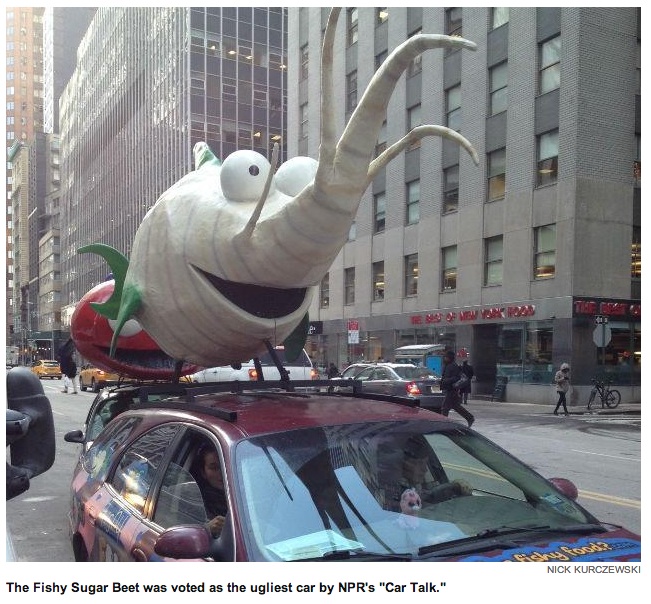
“Just in time for the holiday season, the ugliest car in the United States has ended a cross-country journey right here in the Big Apple. The News caught up with this and several other ‘fishy’ rides in lower Manhattan, for an educational lesson in nutrition – and how to manage a fleet of veggie cars on the streets of NYC.
It’s not everyday you spot a large vegetable on the roof of a car.
“We’re here with the fishy food tour. We’re touring across the Western United States to call attention for the need for labeling genetically engineered foods also known as GMOs”
The vegetables represent the most common genetically modified crops.
“Labeling GMOs is important not only to the health of our families and farms but also for our food democracy.”
A battle that Rica Madrid says has been ongoing with global GMO producers Monsanto and Syngenta.
“Monsanto would have you believe that GMOs are nutritionally equivalent to any other food that farmers can produce.”
But Madrid begs to differ.
“GMOs are quite different from traditional farmers methods of selective breeding and hybridization. GMOs are created in a labratory by scientists who can turn genes on and off, but we have no idea what the long-term impact is going to be.”
And for that reason Madrid and the Fishy Fleet crew started their campaign in Seattle in August and will end up in New York City sometime in December, in hopes of spreading awareness about labeling GMOs.
Source: Roma Villavicencio, KOBI 5
Also see:
+ ArkLaTex: “Fishy Food Fleet” hits the streets
+ WWLP: “Fishy Food Fleet” hits the streets
Fishy Food Cars Announce 6,000 Mile Tri-Coastal Tour
Journey from Seattle to New York for GMO Labeling Begins November 7
WASHINGTON, DC – On November 7, GMO labeling activists will set out on a cross-country 6,083-mile journey from Seattle to New York City for the “Are We Eating Fishy Food? Tri-Coastal Tour.” The tour features five mutant GMO art cars fitted with 300 pound roof-mounted sculptures that call attention to the need for labeling genetically engineered (GMO) food. The tour begins two days after the world learns if voters in Washington state approved I-522 requiring labels for food that has been genetically engineered.
The food democracy activists hope their second cross country tour will further activate Americans on the need for the Food and Drug Administration (FDA) to label GMO food as is done in 64 other countries. A video with highlights from the first cross-country tour can be found at www.AreWeEatingFishyFood.com along with background on each of the art cars.
“The Fishy Food art car fleet’s cross-country swim from Seattle to New York will get people talking about the importance of GMO labeling,” says David Bronner, President of Dr. Bronner’s Magic Soaps, whose company supported the creation of the art cars.
The first tour visited thirteen states and nine state capitals in August in a 3,300-mile journey from Washington, DC, home of the fishy food cars, to Seattle to support Yes on 522 campaign. The new Tri-Coastal Tour will follow a complete schedule and can be found at www.AreWeEatingFishyFood.com/tour/
“People want healthier food than what GMO food has to offer,” says Rica Madrid, coordinator of the Are We Eating Fishy Food? Tour. “You can measure the impact these educational vehicles have by the reaction and excitement they generate and the large number of shares we see in social media,” says Madrid.
Since 2011 citizen activism has pushed for information about what’s in our food. That year, the Right to Know March for GMO labeling walked 313 miles from Brooklyn, NY to the gates of the White House in Washington, DC to demand President Obama act on his promise to label GMO food.
Genetic Engineering means more herbicide. Chemical companies genetically engineer DNA from bacteria into food crops to either produce or tolerate the chemicals they sell. No long-term independent safety studies have been performed on adverse health effects of GMO eating GMOs. Overuse of pesticide creates resistant superweeds and superbugs, which leads to increased chemical application. Now chemical companies like Monsanto and Dow are engineering resistance in food crops to much more toxic weed killers like Dicamba and 2,4 D, the main ingredient in Agent Orange.
Currently 64 countries—EU nations, China, Russia, Japan, Brazil, and South Africa included—require labeling of GMOs; US consumers can currently only rely on voluntary labeling to determine whether food products have been altered through genetic engineering.
Origins of the FishyFood Cars
The first car in the Fishy Food fleet was “Poppy,” aka the Fishy Corn Car. Created in September 2011 by César Maxit and the DC51 Artist Collective, Fishy Corn accompanied the Right2Know March, as a support vehicle carrying leaflets, organic snacks and water as it raised awareness with marchers. Fishy Corn then went to Monsanto headquarters in Creve Coeur, Missouri for the 2012 annual shareholder meeting with activist Adam Eidinger. He parked the car on the agribusiness giant’s campus and debated Monsanto’s CEO Hugh Grant on GMO labeling during the meeting. A secret video of the encounter went viral online shortly afterwards.
In January 2013, Maxit began building four more mutant cars using extensive volunteer labor from the Washington, DC artist community. Since then, Fishy Sugar Beet aka “Rooty,” Fishy Apple aka “Goldie,” Fishy Soybean aka “Soja Girl,” and, most recently, Fishy Tomato aka “K-Sup” have driven across America. Collectively, the cars have been driven over 120,000 miles.
Members of the media are encouraged to embed with the Are We Eating Fishy Food? fleet for some or all of the tour. Contact Adam Eidinger at 202-744-2671 or [email protected] to make arrangements.
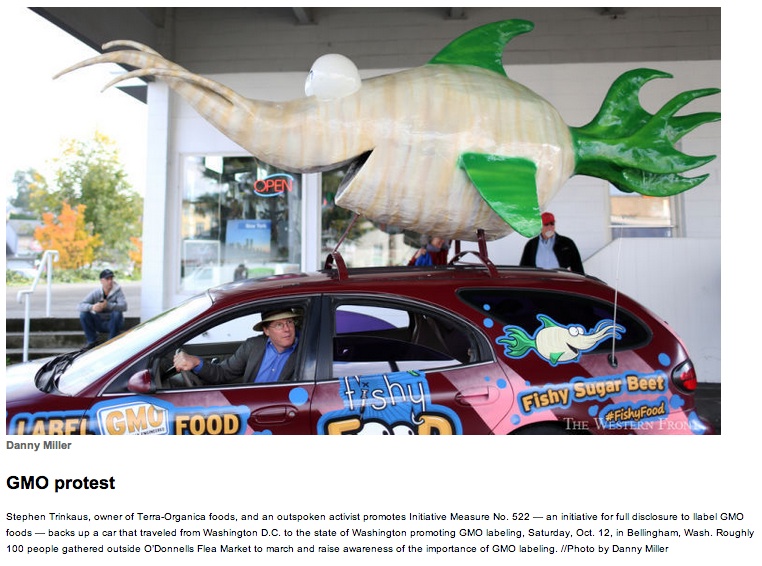
Washington residents may notice two cars unlike any others. A wide-eyed tan and green fish/beet known as “Rooty” and a cherry red fish/tomato known as “K-Sup” smile down at spectators from the tops of two cars.
The cars were created for the Right2KnowMarch against genetically modified organisms (GMOs) in Washington D.C. this summer and were driven across the country to Washington state in mid-August.
Nancy Metcalf, a local anti-GMO activist, has been driving K-Sup since August.
“[My car] features what was known as the ‘flavor savor tomato,’” Metcalf said. “It was the first genetically engineered food available on the market to consumers, but it totally failed because people were not trustworthy of GMO food at that time.”
The red tomatoes were injected with flounder fish genes to help support America’s industrial food chain to keep tomatoes ripe on the vine longer during cold months, Metcalf said.
Except the GMO chemicals injected into the soil inhibit the plant from absorbing all the minerals it needs to be healthy, Metcalf said.
In return people who eat the plant are also mineral deficient, Metcalf said.
The car also captures the attention of many onlookers.
.
“One day I went out to run errands and thought it would take me about an hour and a half, but it ended up taking me about four hours because I ended up chatting with so many people about the car and about GMOs,” Metcalf said.
Reactions to the cars have been almost entirely positive with people smiling and waving as it putters down the road.
“We’ve only had one person loud and proud flip us the bird,” Metcalf said.
At first, Metcalf said she was very cautious driving over 55 mph. On windy days she can feel K-Sup wiggling on top of the car.
The key is to accelerate and take corners slowly as well as give cars in front a comfortable distance, Metcalf said.
K-Sup has been driven back and forth to Washington multiple times in order to raise awareness for GMOs in support of Initiative Measure No. 522, which would require GMOs to be clearly labeled and is featured on the general election ballot in November.
The other cars feature fishy-wheat, fish-corn and fishy-apple, fishy-soybean and fishy-sugar beet. They will tour the country a second time back to their proper owners in Washington D.C. by New Year’s.
The cars were designed by César Maxit and built by fiberglass and welding specialist David Jackson from Washington D.C., with funding from Dr. Bronner’s Magic Soaps, according to the Label GMO Food website.
The sculptures on the cars are reinforced with steel and the shape was molded with chicken wire and papier-mâché with a fiberglass glossy finish, Metcalf said.
Metcalf will continue to drive the cars until after the November election, she said.
On August 5, 2013 a group of food labeling activists set out on a cross-country road trip from Washington, DC to deliver the fishiest cars in America to GMO labeling activists in Seattle, Washington. This video documents their epic 9 day, 3,000 mile journey across America.
Please help support GMO labeling in America by donating to the Yes on 522 Campaign.
Moms across America deserve to know what they are feeding their families. This mother spotted the Fishy Fleet while driving with her daughter last month. A big thanks goes out to mothers like her who have helped put Initiative 522 on the ballot in Washington state.
Port Townsend organic food outlets support GMO labeling
By Charlie Bermant, Peninsula Daily News
PORT TOWNSEND — The Food Co-op and the Jefferson County Farmers Markets have endorsed an initiative on the state Nov. 5 general election ballot that would require the labeling of foods that contain genetically modified organisms, or a GMOs, in food outlets.
Port Townsend two major organic food merchants announced support of Initiative 522 last week.
If passed, it would require all genetically modified food sold in the state to be identified on its packaging.
“It’s important that people know what’s in their food and can make a choice about what they are eating,” said Ann Pougiales, vice president of the Jefferson County Farmers Market board.
Pougiales said that GMOs are not an issue at the farmers markets in Port Townsend and Chimacum, since organically grown produce is almost always free of modifications, aside from corn.
“Those selling at the farmer’s markets use organic seeds and know the source, so if there is any GMO food there, it is without the knowledge of the vendor,” she said.
Kathie Meyer, the Food Co-op’s marketing and outreach, education and marketing manager, said the requirement to label GMO food wouldn’t change how food manufacturers do business “because they are changing their labels all the time.
“We believe that everyone has the right to know what is in their food,” she said.
On Friday, the Co-op hosted an appearance from Nancy Metcalf, a farming activist from Van Zandt, a small Whatcom County town, who drove a car decorated with a representation of a giant tomato with the fins and tail of a fish on its roof and a host of pro-522 signs.
The car, a 2003 Honda Civic with 83,000 miles, was driven from Washington, D.C., and will be circulating around the Northern Olympic Peninsula over the next few weeks as part of the I-522 campaign.
Metcalf said the giant tomato fish weighs 300 pounds and consists of a steel frame covered by chicken wire and wrapped in papier-mache and fiberglass.
“When the car is parked outside of a store, people come up to me out of the blue and want to talk about the issue,” she said.
“So what would normally be a 90-minute shopping trip can take six hours.”
Pamm Larry — who started Proposition 37, the GMO labeling act that was voted down by California voters in 2012 — also will be appearing at speaking engagements in Port Angeles, Sequim and Port Townsend.
Major grocery chains and agribusiness interests spent $46 million fighting Propostition 37, the online Seattle PI said.
Larry will speak at:
— Quimper Unitarian Universalist Fellowship, 2333 San Juan Ave. in Port Townsend, at 7 p.m. Friday.
— Nash’s Farm Store, 4681 Sequim-Dungeness Way in Sequim, at 1:30 p.m. Saturday.
— Little Theater at Peninsula College (Room J-16), 1502 E. Lauridsen Blvd. in Port Angeles, at 6:30 p.m. Saturday.
These events are free and open to the public.
Larry will speak about Prop 37, why it failed in 2012, and why she feels it is important to pass I-522.
Larry, a farmer, midwife and grandmother of three, said she was so concerned about the modern-day food system that she quit her day job to educate herself on GMOs and how to apply for a ballot initiative.
Annmarie Gianni Skin Care is funding the tour.
“I-522 will require that most foods containing GE [genetically engineered] and/or GMO ingredients must be labeled, and will give each of us the Right To Choose what we eat and feed our families,” the Community Rights Coalitin of Jefferson County says on its website, http://communityrightsjeffersoncountywa.org.
The initiative has drawn heavy opposition.
Supporters of the initiative have put together a $3.5 million war chest, the Seattle PI said last week.
Contributors include DuPont, Dow Agrisciences, BASF Plant Science and Montsanto.
The “No on I-522” campaign quotes Mike LaPlant, president of the Washington State Farm Bureau, as saying that “I-522 would force Washington farmers and food companies to implement costly new labeling, packaging, distribution and recordkeeping requirements that do not exist in any other state.”
The campaign against the measure also says that 522 would require fruits, vegetables and grain-based products to be labeled but would exempt meat and dairy products from animals fed GE grains.
Traveled from DC to Missouri in mid-August with “The Fishy Fleet” (an offshoot of anti-GMO protest group Occupy Monsanto). It was a convoy of 17 activists piled into a 1960s-era RV and 5 “fishy” cars with friendly looking frankenfood sculptures on top…
Near Pittsburgh the fleet held up traffic when a toll booth attendant took a pix with her iPhone. One Ohio woman, who followed “Fishy Sugarbeet” into a gas station, proclaimed: “That’s the freakiest thing I’ve seen in Perry County — lately!”…
Outside Monsanto Corporation’s global headquarters in Creve Coeur, Mo., company stock holder and convoy organizer Adam Eidinger read aloud from his shareholder resolution asking Monsanto to “work with the FDA to develop food labeling guidelines for American consumers that discloses whether genetic engineering was used to produce the food”…
When asked for a statement, Monsanto says it supports voluntary labeling, but that mandatory labeling in the “absence of any demonstrated risks…could imply that food products containing these ingredients are somehow inferior to their conventional or organic counterparts.”
Riding around in a car topped with a giant half-vegetable, half-fish is bound to attract attention.
As Nikolas Schiller drives past the National Zoo in Washington, D.C., pedestrians gawk, kids point, and tourists snap pictures.
An oncoming driver pulls up in a stretch of slow traffic and asks, “What is it?”
Schiller explains it’s a Fishy Food Car and hands the man a card bearing a cartoon that asks, “Are we eating fishy food?”
It’s a visual pun. For opponents of genetically modified organisms (GMOs), there’s something fishy - suspicious - about putting genes from other species into food crops, and they want foods containing GMO ingredients to say so on the label.
Labeling laws
There are no fish genes in the GMOs on the market today, but nearly all of the corn, soybeans, cotton and sugar beets growing in the U.S. contain bacterial genes that help farmers control weeds and insects.
Schiller’s day job is with a D.C.-based public relations firm. But this summer his fishy apple car will join the fishy corn, soybean, sugar beet and tomato cars driving cross-country to Washington State, where a GMO labeling law is on the ballot this fall.
Momentum is behind them. Labeling laws were approved in Connecticut and Maine earlier this year.
Labeling everything containing a GMO ingredient would take a lot of ink. They’re in 80 percent of the foods on supermarket shelves, according to the Grocery Manufacturers Association, especially anything processed, in a bottle, box or bag.
Novel food
But are they bad for you? Schiller acknowledges that the only evidence of harm from GMOs is anecdotal, but he’s suspicious.
“This is a novel food. Our grandparents and previous generations didn’t eat this,” he said. “And now all of a sudden we’re seeing higher incidences of food and health issues. And so if [GMO makers] are saying, ‘Oh, everything’s safe,’ but nothing’s labeled, we really can’t trace the safety.”
Health authorities from the U.S. Institute of Medicine to the World Health Organization have said there’s nothing to fear from GMOs.
And the U.S. Food and Drug Administration says there is no substantive difference between GMO and conventional ingredients, so it can’t require labels.
On the other hand, products without GMOs may say so on the label, and these are now some of the hottest items in the supermarket. Last year, sales of certified-organic products grew 7.4 percent, twice the rate of the food sector as a whole. And foods with the “Non-GMO Verified” seal passed $1 billion in sales in 2011.
‘We should’ve been talking about this’
This has not gone unnoticed by the biotech industry.
This summer, the industry-sponsored Council for Biotechnology Information made an unusual, if understated, admission.
“We recognize we haven’t done the best job communicating about GMOs,” Executive Director Cathy Enright said in a press release.
She was more frank in person.
“We should’ve been talking about this for two decades,” she said, adding that in the last few years in particular, social media have taken opposition to GMOs to a new level. “We haven’t even been near social media.”
Transparency
But for opponents like Schiller, it’s not about a failure to communicate. For one thing, he wants to see the results of safety tests the companies submitted to the FDA.
“And they can say, ‘This is proprietary information. We’ve done our testing. We don’t have to disclose to the public,’” he said. “Anytime you have a veil over something, people are going to want transparency. People are going to want sunshine. And as long as you withhold that, people are gonna think, ‘This is kinda fishy.’”
Sunshine might be about to break through. For the first time, Enright said, the companies’ testing data will be available online at a new website: GMOAnswers.com.
“It’s gonna be technical,” she said. “But we’ve been asked, ‘Show us your data.’”
It’s part of a new pledge of openness and dialogue. Enright said the big seed companies will be opening their doors for people to come and see what they do. There will be dinners where supporters and opponents can sit down and talk. She said a panel of volunteers will be answering any questions the public might have.
“We believe that if people have the information at hand, that it won’t feel fishy; that they’ll be more comfortable with this technology,” she said.
But with a growing number of states considering GMO labeling laws, the industry has a lot of catching up to do.